
Brakes are great
Brakes are great!
Add brakes to your portfolio and avoid the pain of the next market crash!
On a bicycle or in your car brakes allow you to reduce your speed to navigate an intersection more carefully, or even help you come to a complete stop and prevent a collision. Nobody would even think about driving around without brakes. It would be illegal. Action movies sometimes have a scene where the protagonist is driving, and the brakes quit working due to some sabotage. What unfolds is universally understood as extremely dangerous. Since we all drive, we can all relate to the fear of not having brakes and losing control of our car.
Here is what we'll cover in the report below:
While your car, truck, or SUV has the obvious purpose of transporting you to important destinations, your investment accounts are also ‘vehicles’ that are tasked with taking you to very important financial destinations. “Investment Vehicle” is even a term used to describe investments. The growth or income potential of the ‘investment vehicle’ might be analogous to the engine, powering your desired investment result. But, does your ‘investment vehicle’ also have brakes?
Ownership of quality companies through stocks (or products that own stocks) is the best way to seek capital growth long term but owning stocks in the short term can at times be the best way to see losses as well. The volatility seen in the stock market is sometimes referred to as a ‘roller coaster’ because once you are on a roller coaster you are forced to endure whatever dips and turns the track dishes out. You can’t smooth out the track or exit the ride at your desired point.
Here's what a "smoother ride" of a financial vehicle with brakes looks like:
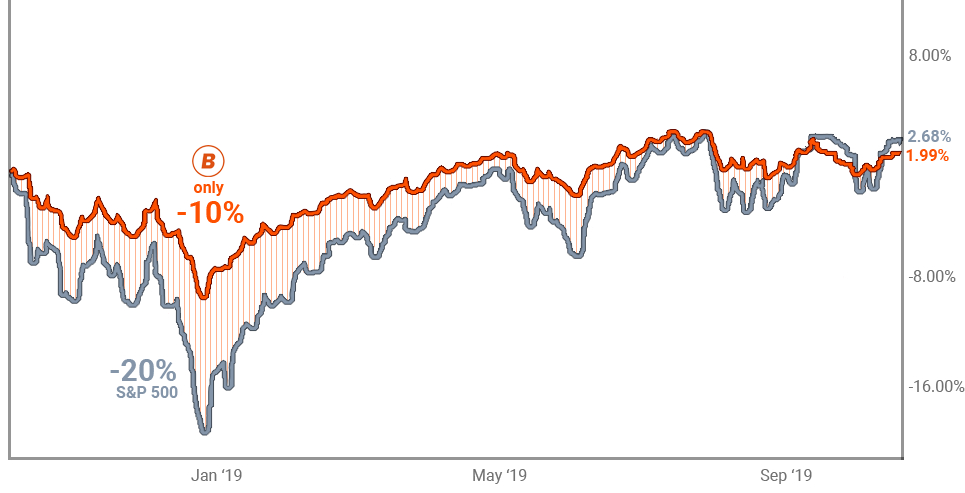
Source: YCharts: Bullseye 'brakes' equity holding vs. the S&P 500: October 1, 2018 - October 21, 2019
The orange line is the daily performance of one of the products with brakes that we use, and the gray line is the S&P 500 over the same period, October 1st, 2018 through October 21st of 2019. The S&P 500 fell 20% from October 1st to December 24th, 2018, while the hedged product only declined 10%. Having half the downside risk (risk of losses) in that time period would certainly quality as brakes slowing and decreasing the losses in that volatile period. But, nine months later the two approaches had virtually the same return (less than 1% difference).
When discussing brakes, we need to review some basics. Firstly, what we use is NOT an annuity, non-traded security or some other illiquid, high commission rip off. They are simply specialized ETFs (exchange traded funds) that employ proven, time tested methods to participate in the market and protect against losses. These ETFs use long term equity options to participate in gains and allocate a portion of the funds to also buy long term options that will gain if the market falls. These equity options have been used for decades by both individual investors and institutions such as mutual fund families, pensions, insurance companies and hedge funds. They are similar to the commodity options used to trade and sell grain for hundreds of years.
We can make the roller coaster ride smoother and you can exit at any time because these financial products can be bought or sold any minute the stock exchange is open. If we believe potential losses could be greater than the protection these products offer, we can sell them at any time. However, currently by using them we are able to reduce portfolio volatility and offer a backstop or buffer on losses of 9-15% if held to the product’s maturity. Recently our firm rebalanced many client accounts to own these defensive brake products for a 3-month period, buying them in late July and purchasing an October 1 maturing ETF. This gave our clients about 12% downside protection with just a three-month holding period instead of 12 months. Then the funds were simply invested into another ETF product to continue to offer them protection for their hard-earned money.
The benefit of these investment techniques goes beyond the hedge or buffer against losses if held till the planned endpoint. The greatest benefit these products have is far less downside risk to investors during market turmoil, months before the maturity built into the product. The brake products we use do not eliminate all equity downside risk, and we also use equities that are not hedged, but when used in an appropriate portion of an equity portfolio this approach does provide a substantial downside risk reduction, and preserves your capital when risk levels are highest.
Let us add brakes to your portfolio. Contact us for a customized report on how much we can reduce your downside stock risk with this modern, institutional approach.
Past results don’t guarantee future performance. All investing involves risk, including the potential loss of principal, and there can be no guarantee that any investing strategy will be successful. Diversification does not guarantee a profit or protect against investment loss.