Category Archives for "Insight"

Mutual Funds VS. ETFs

Mutual Funds VS. ETFs

by Tim Guthrie, CFP®– Founder and Chief Investment Officer of Bullseye Investment Management

Mutual Funds

have been around for about 100 years. The oldest mutual fund still in existence today (symbol-MITTX, Name- Massachusetts Investors Trust Class A) was started in 1924. Mutual funds allow anyone to obtain excellent diversification and professional management. Mutual funds invest in financial assets– stocks, bonds, commodities, and real estate securities.

Stocks are ownership in a profit seeking enterprise. Each share of stock represents the same size “slice” of a company. Someone may own 100,000 shares, and someone else may own 10 shares, but each share is equal. Over the long term, stocks have represented the best opportunity for most investors as owning profitable, growing companies over time can result in very good growth of your wealth.

Bonds are debt. When you buy a bond, you are loaning money to a government or company. Bonds typically pay a “fixed,” consistent rate of interest (rent on your money) at regular intervals. At the end of the time for which the bond is offered, the maturity, the bond holder is returned their principal. This is the face value of the bond, usually, $1,000 per bond. Bank CDs work the same way.

Commodities come in several varieties: Energy (oil, natural gas, coal, uranium), agricultural (corn, wheat, rice) metals, (iron ore, tin, aluminum bauxite) and precious metals (gold, silver, platinum). Many commodities are used by all of us every day, but investing in commodities for novices can be fraught with many risks.

Real estate securities are a way to invest in a skyscraper office building or giant mall without having to buy the entire building. Companies in the business of owning and managing commercial real estate can sell shares to the public, just like any other company. This way you can participate in the opportunity of owning a warehouse, strip mall or major apartment complex.

While the various types of financial assets offer opportunities, most investors do not necessarily know which stocks, bonds, commodities, or real estate to own. Additionally, most folks, even prosperous folks, do not have enough resources to be very diversified. This is where mutual funds come in handy. A stock mutual fund will often own 50-200 different stocks spread across many different industries and geographies. This decreases risk as compared to owning stocks in just a few different companies. A professional manager chooses and “manages” (monitors and evaluates) the holdings. A bond mutual fund often owns hundreds or even over one thousand different bonds, with the managers choosing what to own, and when to buy and sell bonds based on interest rates and many other economic conditions.

I hope you can see some of the benefits of mutual funds. You can spread your money easily over many companies, and let professionals take the burden off your shoulders. These factors reduce risk and increase the chances that you will have a profitable experience. Owning mutual funds is like buying clothes already made to your size as compared to sewing your own clothes. I can tell you that I look better letting someone else, an expert, design and manufacture my clothes.

Usually twice a year, the mutual fund sends a report that lists all the securities they own, and if you desire you can read it to learn more about your mutual fund.

Mutual Funds offer more than just diversification and expert management. They can also allow you to diversify across many stocks or bonds while you simultaneously concentrate your assets in preferred sectors such as software, auto manufacturing, or gold mining.

It can get complicated, so many use experts to build and manage a mutual fund portfolio for them.

Data has shown that those who get professional help earn a higher return per year than those who choose to “do it yourself”

(https://www.ramseysolutions.com/retirement/should-you-pay-an-advisor-for-investing-advice).

With mutual funds dating from 100 years ago, we should expect some new technologies to be applied. Enter the ETF (exchange traded fund).

ETFs

serve all the same purposes as mutual funds and have all the benefits of mutual funds and a few additional advantages. ETFs can have all the benefits of mutual funds when it comes to diversification and professional management. ETFs also come in many varieties, just like mutual funds. We use ETFs in the same way we use mutual funds. We build portfolios that own the securities we want clients to own.

How do ETFs differ? The name is a clue, Exchange Traded Fund. Stocks trade on exchanges throughout the day, usually 9:30am to 4pm here in the US. You could buy 100 shares of WMT (Walmart) at 9:32am and sell the same shares later the same day if needed or desired. ETFs are FUNDS (diversified pools of securities, like mutual funds) that can trade throughout the day, just like stocks. You can buy any ETF at any time throughout the trading day.

Mutual funds can only be bought or sold based on the end of the trading day. You must place your mutual fund order (to buy or sell the fund) before 4pm. Then, all the accounting is done for what the portfolio is worth as of closing prices and the share price is determined and your order is then filled to buy or sell the fund.

This may seem like a small difference, and it is, but sometimes it can be important. We can place orders to buy or sell an ETF at a certain price. You cannot do that with a mutual fund. We can place ETFs in a margin account (where we borrow against the value of your securities). Mutual funds cannot be used in a margin account. This too is a small advantage, but we have had clients buy farms with a margin loan against their brokerage account then secure permanent financing a few months later.

ETFs are more “transparent” than mutual funds. Most ETFs must publish daily, all the securities in the portfolio. Daily is clearly better than every 180 days if you (or we) want to check out the fund’s holdings. We use this feature daily at Bullseye.

ETFs have different, and better tax treatment. ETFs can dispose of securities with gains and get cash in return without legally effecting a “sale.” Mutual funds cannot do this. This means that ETFs can often offer years of growth without passing on the capital gains that mutual funds do. This allows you to control, and postpone to some degree, WHEN you pay the taxes on your gains. Mutual funds do not allow this possibility. This is a large advantage. I have seen clients with $100k in a mutual fund that pushed out $28K in capital gains to a client who has not sold the fund, and now they need $7K to pay the capital gains taxes. This will not happen in a properly run ETF. The ETF holder can decide when to sell, and thus when to take capital gains and pay the taxes, even using the proceeds to pay the taxes. This is a significant advantage.

ETFs are cheaper. The average mutual fund has fees of about 1% per year, and the average ETF has fees closer to 0.4%; so, mutual funds cost 250% more than ETFS on average. This too is a significant advantage.

Not only are ETF annual fees cheaper, but ETFs also have another cost advantage. Many mutual funds have sales loads that can be as high as 5.75% and even more mutual funds have 12b-1 fees that usually cost about 0.25% a year. ETFs do not have sales loads. ETFs do not have 12b-1 fees. If you are using ETFs, you are guaranteed NOT to BE PAYING sales loads on the value of your investment. For those hiring professionals to manage their investments, this is a very big deal. Commission based investment reps do not use significant allocations to ETFs because they cannot get paid up front to use them, so they stick to mutual funds and annuities (even higher fees and commissions).

We understand that some esteemed personalities promote using mutual funds and downplay ETFs. The facts are that ETFs are often cheaper, never have sales loads, can be more tax efficient, and still offer all the advantages of mutual funds. ETFs are the “new and improved” mutual fund, and we use them extensively.

This does not mean that we do not use mutual funds. If a mutual fund is a better fit for our desired application, then will be content to use a good mutual fund too.

How to get started with Bullseye

1. Schedule a call with our team

2. Meet with us for your listening session

3. Get your personalized investment strategy

About the Author

Timothy Guthrie CFP®Chief Investment Officer and FounderCincinatti, Ohiotim@bullseyeinv.com513-774-3325

Have other questions?

Submit the form below and we will be in touch with you shortly.

Full NameEmail Phone NumberMessageSend message
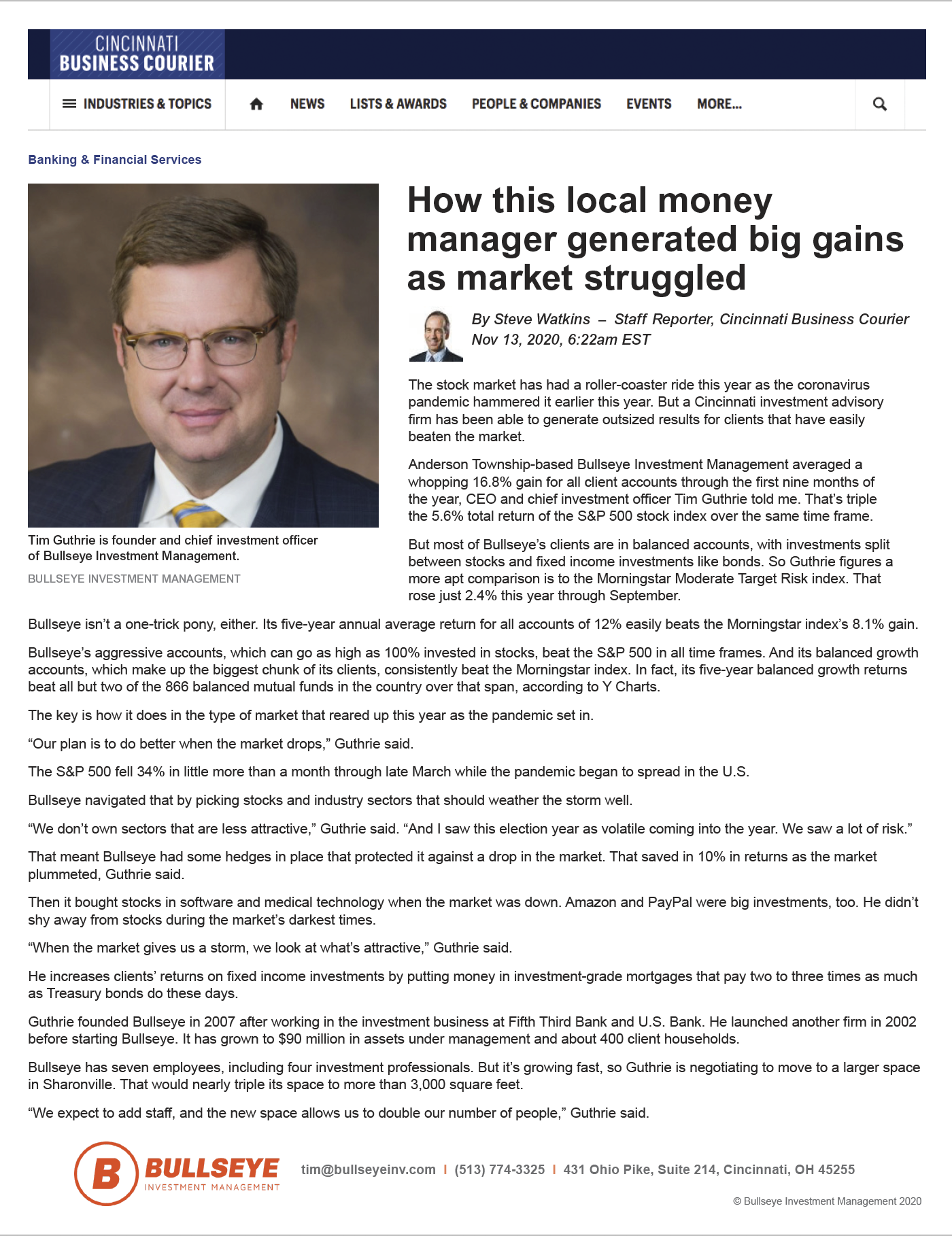
FEATURED: How this local money manager generated big gains as market struggled

FEATURED IN: Cincinnati Business Courier

How this local money manager generated big gains as market struggled

On November 13th, 2020
  – Staff Reporter, Cincinnati Business Courier

Original Article:
https://www.bizjournals.com/cincinnati/news/2020/11/13/money-manager-finds-success-amid-pandemic.html

Tim Guthrie is founder and chief investment officer of Bullseye Investment Management.

The stock market has had a roller-coaster ride this year as the coronavirus pandemic hammered it earlier this year. But a Cincinnati investment advisory firm has been able to generate outsized results for clients that have easily beaten the market.

Anderson Township-based Bullseye Investment Management averaged a whopping 16.8% gain for all client accounts through the first nine months of the year, CEO and chief investment officer Tim Guthrie told me. That’s triple the 5.6% total return of the S&P 500 stock index over the same time frame.

But most of Bullseye’s clients are in balanced accounts, with investments split between stocks and fixed income investments like bonds. So Guthrie figures a more apt comparison is to the Morningstar Moderate Target Risk index. That rose just 2.4% this year through September.

Bullseye isn’t a one-trick pony, either. Its five-year annual average return for all accounts of 12% easily beats the Morningstar index’s 8.1% gain.

Bullseye’s aggressive accounts, which can go as high as 100% invested in stocks, beat the S&P 500 in all time frames. And its balanced growth accounts, which make up the biggest chunk of its clients, consistently beat the Morningstar index. In fact, its five-year balanced growth returns beat all but two of the 866 balanced mutual funds in the country over that span, according to Y Charts.

The key is how it does in the type of market that reared up this year as the pandemic set in.

“Our plan is to do better when the market drops,” Guthrie said.

The S&P 500 fell 34% in little more than a month through late March while the pandemic began to spread in the U.S.

Bullseye navigated that by picking stocks and industry sectors that should weather the storm well.

“We don’t own sectors that are less attractive,” Guthrie said. “And I saw this election year as volatile coming into the year. We saw a lot of risk.”

That meant Bullseye had some hedges in place that protected it against a drop in the market. That saved in 10% in returns as the market plummeted, Guthrie said.

Then it bought stocks in software and medical technology when the market was down. Amazon and PayPal were big investments, too. He didn’t shy away from stocks during the market’s darkest times.

“When the market gives us a storm, we look at what’s attractive,” Guthrie said.

He increases clients’ returns on fixed income investments by putting money in investment-grade mortgages that pay two to three times as much as Treasury bonds do these days.

Guthrie founded Bullseye in 2007 after working in the investment business at Fifth Third Bank and U.S. Bank. He launched another firm in 2002 before starting Bullseye. It has grown to $90 million in assets under management and about 400 client households.

Bullseye has seven employees, including four investment professionals. But it’s growing fast, so Guthrie is negotiating to move to a larger space in Sharonville. That would nearly triple its space to more than 3,000 square feet.

“We expect to add staff, and the new space allows us to double our number of people,” Guthrie said.

Copyright and Attribution:
No claim is made to the exclusive right to the use of the content above. All copy and trademarks mentioned or used are the property of their respective owners. 

Roth IRAs as a Source of College Funds

Roth IRAs as a Source of College Funds

By Rob Stone—Bullseye’s Investment Advisor in Louisville

Roth IRAs have been around for a little over 20 years and are more popular now than ever.  Two things are fueling this.  The first is historically low current income tax rates.  The second is the very real risk of escalating tax rates.  Concern about the public demand for more and more government-subsidized services makes us wonder what the tax rates will be when we retire.  Roth IRAs, of course, provide tax-free retirement income if managed correctly, dissolving this very real concern.

An oft-fielded question at Bullseye is, “What is the best way to save for my kids (or grandkids) college education?”  At Bullseye we highly recommend Coverdell Educational Savings Accounts because of our ability to choose from unlimited investments to achieve maximum returns.  We do this the same way as our client’s retirement accounts, by researching and selecting investments that we feel are the absolute best in their category.

As a side note, we find most state sponsored 529 plans have very limited choices and are historically loaded with such poor performing options that the tax advantage of using these plans are completely negated by poor results.

Despite our affinity for the Coverdell ESAs, they have their limitations.  Contributions are capped at $2000 annually per child and there are income phaseout limits for high income families.  These limitations can be dealt with by incorporating a Roth IRA as part of the plan to save for college expenses.  Because Roth IRA’s tax advantages, they can be a tax-favorable funding source above and beyond the Coverdell ESAs.  While we do not recommend anyone use the entirety of their retirement funds to subsidize college for a child, using Roth IRA assets can be part of the formula.

How?  When using Roth IRAs for qualified college expenses, original contributions can be withdrawn penalty-free prior to age 59 ½.  Roth IRAs are treated differently than a traditional IRAs, in that funds are withdrawn in a first-in first-out basis.  This means that contributions will come out before any earnings do.  While earnings and dividend growth are not eligible for penalty-free withdrawals, contributions are.  So, unless more is pulled out than was contributed, taxes and penalties will not be a problem.

There are three other very important and attractive features of using a Roth IRA to fund college education.  Firstly, in the event your child decides not to attend college, or receives a full scholarship, the money is yours to remain in your own account for an even better retirement.  (That is not true for 529 plans.1)  Secondly, retirement funds are not considered by FAFSA in ‘Expected Family Contribution’ (EFC) calculations while performing financial aid assessments.  If you’ve yet to fill out a FAFSA, then just know that this can be critical.  Thirdly, income phaseout limits can also be circumnavigated using the ‘Back Door’ Roth Conversion process2 to invest as much you would like to each year.  But even with these three key advantages, perhaps the greatest benefit, as with the Coverdells, is the lack of investment selection encumbrances enabling Bullseye to seek out and choose only high performing quality investments for you.

Worth noting is that there is a minimum 5 year investment window that must be met before any Roth funds can be withdrawn penalty-free, so start saving early.

At Bullseye, we are always ready to answer any questions you might have about investment and savings options that are best for you and your personal situation.

1 If you want to use the funds in a 529 plan for anything other than qualified educational expenses, then you must pay a 10% penalty plus income tax on the funds.

2 The ‘Back Door’ Roth Conversion Process:  Because there is no income limit on the ability to convert traditional IRAs to Roth IRAs if you qualify, this is often an ideal way to increase your Roth contributions.  This method requires a non-deductible traditional IRA contribution (usually in a new traditional IRA account opened just for this purpose).  Once the traditional IRA contribution is made, the funds can be transferred to a Roth IRA.  Please call Bullseye if you have any questions about this.

How to get started with Bullseye

1. Schedule a call with our team

2. Meet with us for your listening session

3. Get your personalized investment strategy

Have other questions?

Submit the form below and we will be in touch with you shortly.

What Does that ‘Small’ Distribution Really Cost?

What Does that ‘Small’ Distribution Really Cost?

By Vickie Corpuz--Bullseye Investment Management’s Office Manager and Math Maven

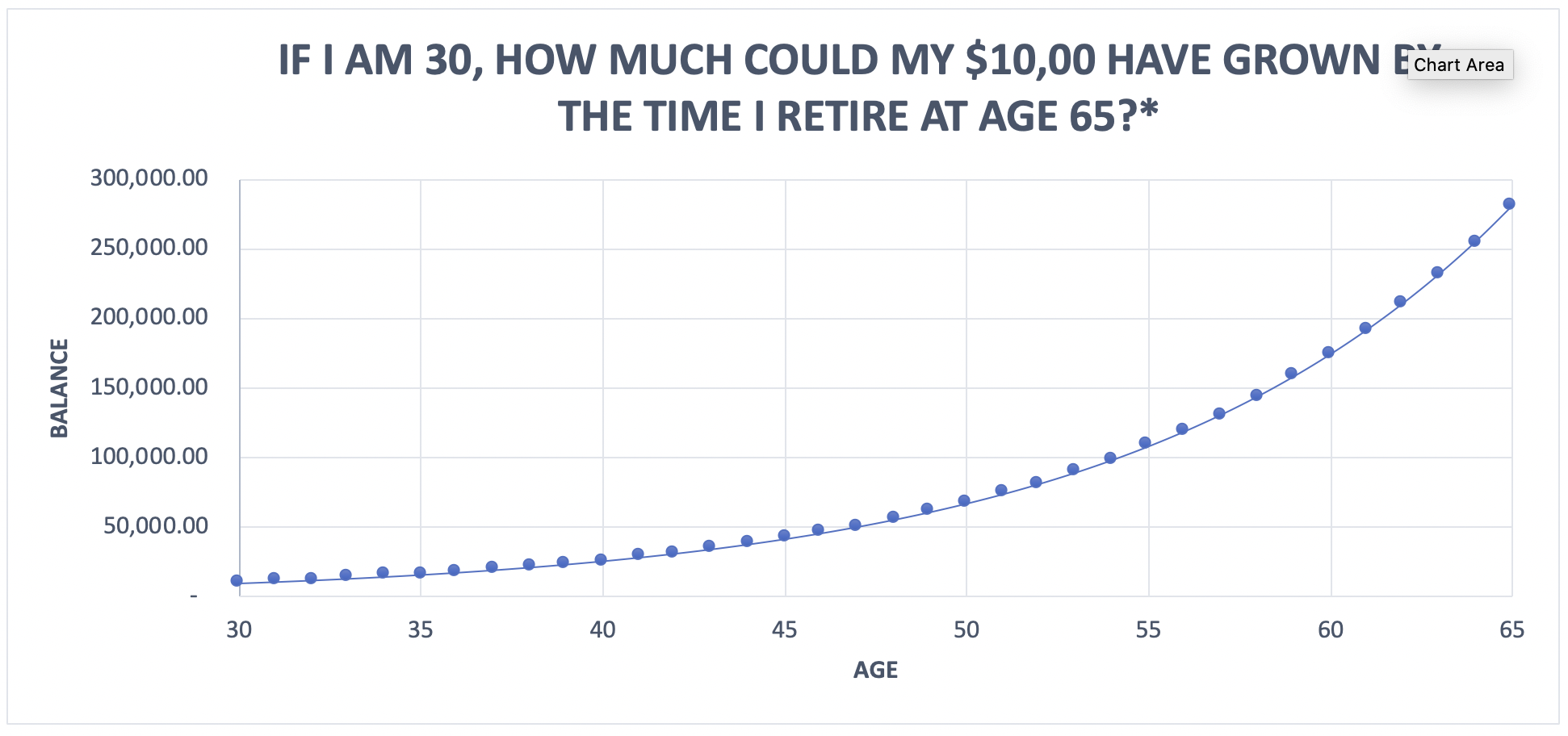
It is not uncommon at all for pre-retirement investors to withdraw some funds from their retirement account in order to make significant purchases or pay off debt.  We generally advise against that and work with our client to develop a plan that would be much more beneficial to our client’s long-term financial future.  Why?  Because removing a portion of your investments also eliminates all of the growth that those funds could have had.  Usually the lost value of the funds is quite surprising for an investor.  In order to set up a hypothetical situation, I will suppose that you will retire at age 65.  If you are 30 years old and redeem $10,000 from your account, the lost value by the time you retire is $281,024.  Shocking I know, but that is using only a 10% return each year.  If your account out-performs that 10% number, it would be even more.  So that car or new furniture probably cost you way more that you could have imagined.

The graph below shows the growth for $10,000 if the return is 10% each year.  If you would like to see the spreadsheet with the month-to-month balances, just contact me, VickieCorpuz.  I may be new to the investment world, but as a retired math teacher, I am happy to help clients understand the implications of investment decisions.

How to get started with Bullseye

1. Schedule a call with our team

2. Meet with us for your listening session

3. Get your personalized investment strategy

Have other questions?

Submit the form below and we will be in touch with you shortly.

Why Should You Care If You Work with a CFP?

Why Should You Care If You Work with a CFP® Professional?

There are dozens of financial advisor certifications and designations—many of the newer credentials require relatively little coursework and training compared to the older, more established designations.1 But, according to Kiplinger’s only 3 designations matter.2 Those are CFP®, CFA, and CPA. Of course, business owners will hire a CPA (Certified Public Accountant) to help them with their accounting. And many investment banks hire CFAs (Chartered Financial Analysts) to deal with complex financials. But who hires a CFP®? You should. 

The Certified Financial Planner is largely recognized as the highest standard in the personal financial planning field.3 This is because of the significant amount of material that must be learned. A Certified Financial Planner® (CFP®) has to study for 18 to 24 months and usually puts in about 1000 hours of studying in order to learn the material and pass a rigorous exam.4 They must show competency in more than 100 topics, including retirement planning, stocks, bonds, taxes, and estate planning.5

But beyond the academic aspect of the certification, one of the most notable requirements of the CFP® is the fiduciary component. They are bound by high standards set by the CFP Board’s Code of Ethics.6 CFPs® pledge to uphold the principles honesty, integrity, competence, fairness, confidentiality, professionalism and diligence and outlined in that Code. Every CFP® HAS to put their clients’ needs ahead of his/her own.7 Most financial advisors do NOT have to do this—shocking, I know. The CFP® Board even monitors its members to make sure they continue to act as they should. 

How to get started with Bullseye

1. Schedule a call with our team

2. Meet with us for your listening session

3. Get your personalized investment strategy

A CFP® works with his or her clients to make sure the clients understand their options and make financial decisions appropriate to their situation and their goals, both short term and long term. The financial climate is complex and always changing. So the CFP® Board requires CFPs® to continue to learn about these changes. Every CFP® takes continuing education classes to make sure they are aware of the changes and understand what the changes mean for their clients.

Don’t settle for a financial advisor that makes commissions on what you are sold or makes more money if your portfolio has more transactions. Look for a Certified Financial Planner® that is fee-only for solid advice. This elite group of advisors will act in your best interest. Your future financial success may depend upon solid, honest advice from a knowledgeable fiduciary.

Tim Guthrie, CFP® has been a Certified Financial Planner® continuously since 1995. His firm, Bullseye Investment Management is a fee-only full fiduciary investment advisory firm with offices in Cincinnati, Dayton, Akron, Louisville, and Ashland. Everyone at our firm embraces the standards entailed by the CFP® Board. Any of our investment advisors would be happy to meet with you and find out about your concerns and answer any questions that you have about financial planning or investing. There is no cost or obligation for a meeting.

About the Author

Timothy Guthrie CFP®
Chief Investment Officer and Founder
Cincinatti, Ohio
tim@bullseyeinv.com
513-774-3325

Have other questions?

Submit the form below and we will be in touch with you shortly.

Five Savvy Year-End Strategies for Retirement Investors

5 Savvy Year-End Strategies for Retirement Investors

by Tim Guthrie, CFP® - Founder and Chief Investment Officer of Bullseye Investment Management

The end of the year is a natural time to evaluate your financial plans, results, and plan for the new year. It is also a deadline for some tax related matters. The old adage “what gets measured is what gets done” is very applicable here. This article will explain some techniques to help you evaluate your financial success this year and make sure you take advantage of opportunities while they are still available.

Strategy #1

Make sure that you have maximized your retirement plan contributions.  

This can mean contributing the legal maximum allowed contribution or that you have contributed all that you can afford into these plans.  Below find the customary legal maximum contributions:

  • The maximum IRA or Roth IRA contributions for someone under 50 years old for 2019 is $6000.1 
  • The maximum IRA or Roth IRA contribution for someone who is reached 50 years old in 2019 is $7000.1

Employment-based retirement plans have much higher contribution limits allowing you to create much more wealth.  The limits for 2019 below:

  • 401(k) and 403(b) Employee Deferral Limit1 - 2019 Limit1 $19,000                       
  • 457 Employee Deferral Limit - 2019 Limit1 $19,000                       
  • Catch-up Contribution2 - 2019 Limit1 $6,000

If you can afford to make the maximum deferral, it is likely that this is an excellent idea.  The exception to this would be if the investment options in your plan are particularly poor.  If you cannot afford to make the legal maximum contribution, you still need to satisfy yourself that you have saved enough to achieve your retirement goals.  Bullseye Investment Management can assist you with the retirement planning calculations to determine what level of savings is necessary to reach your goals.

Strategy #2

Use the “back door” Roth Conversion Process to make contributions to your Roth IRA  

If your income is too high for regular contributions.  Roth IRAs are the greatest tax break in history.  You get to invest money and let it grow tax-free.  Then when you redeem the funds, that income is tax-free.  However, congress capped the income for people to receive this amazing tax benefit.  If you are married and file your taxes jointly, the maximum income limit to make a full Roth contribution is $193,000.  It may be possible to get around this though if you use the “back door” Roth Conversion Process.  Because there is no income limit on the ability to contribute to a traditional IRA, it is possible to contribute to a traditional IRA then convert those funds to a Roth IRA if you qualify.  This method requires a non-deductible traditional IRA contribution (usually in a new traditional IRA account opened just for this purpose).  Once the traditional IRA contribution is made, the funds can be transferred to a Roth IRA.  You do have to fill out IRS form 8606, but this method is IRS-approved.  Please call Bullseye if you have want to learn more about this wealth-creation technique.  The tax advantages of Roth IRAs are powerful.  Don’t miss this opportunity if you qualify and have the funds.

How to get started with Bullseye

1. Schedule a call with our team

2. Meet with us for your listening session

3. Get your personalized investment strategy

Strategy #3

Use Tax Loss Harvesting to save money on your taxes  

Tax loss harvesting is a strategy for reducing your capital gains taxes long term in taxable investment accounts.  We do not desire losses, but having some losses are a fact of life for nearly every investor.  Further, losses in taxable accounts have a real dollar value.  Fortunately, this has been a good year and most investments are up.  But, if you have a taxable account (not an IRA), then you can lock in losses to reduce your capitol gains.  The goal is to minimize your taxes. IRS rules allow an investor to reduce the taxes on capital gains, by subtracting losses from those gains or by ‘carrying forward’ losses from prior years.  

Review your realized gains and losses for the year (‘realized’ is a tax term meaning that the gain or loss is actual, the investment has been sold, and ‘un-realized’ is a ‘paper’ gain or a loss, as the investment has not been sold). Then examine any losses for possible tax loss harvesting.  For example, say your account has seven holdings, and two have losses.  One of those holdings with a loss you still consider having good investment potential.  In tax loss harvesting, we sell that holding to ‘realize’ the loss (now we can use it to reduce taxes on some realized gains, or use it in the future) but then we buy another similar (often nearly identical) investment to stay invested in that sector to benefit when the prices for those securities improves.  Doing this, we have our cake and eat it too.  We get the benefit when the new investment appreciates, but we captured the loss for tax purposes.  Remember, the tax loss has a dollar value.  To continue the example, if the loss ‘harvested’ was $2,000, realizing the loss could save you anywhere from $300 to $600 in capital gains taxes (your capital gains tax rate multiplied by the dollar value of the loss).  This process both lowers your breakeven price for the investment and reduces your tax bill.

Many investment ‘professionals’ do not harvest losses, they simply tell their clients that the investment with the losses ‘will come back’.  The problem with that approach is that it costs their clients real money.  It does, however, reduce the amount of work and expertise required for that ‘professional’.  Don’t let your investment advisor miss an opportunity to save you money.

Strategy #4

Reevaluate your risk tolerance

Many investors fail to adjust their risk tolerance as they approach retirement.  While best way to create wealth in the long-term is owning stocks, short-term fluctuations could still wreak havoc with your retirement plan.  While there are other factors, the simplest way to evaluate your risk is to determine what overall percentage of your retirement account is invested in stocks.  Typically, your employer’s retirement plan will categorize your retirement options based on whether it is a stock, bond, or blended investment.  If 60% of your 401k plan is in stock funds, then your working assumption should be that your account has about 60% of the risk of being in stocks.  If you were content with a high level of risk when you were younger, but are now approaching retirement, you may want to evaluate how much of your wealth is at risk.

This subject is more complicated than the above generalizations.  The risk level among different stock products can vary greatly and bonds do have risks as well.  Our firm specializes in helping clients accurately assess their risk level and build investment plans to match their risk tolerance using modern approaches.  You only have one shot at retirement, let us help you get it right.

Strategy #5

Evaluate the competitiveness of your holdings 

How much have they grown this year?  How does that compare to other investment vehicles?  Many stock portfolios are compared to the S&P 500.  The problem is that if your account is not 100% stocks with 30% of those being in technology, this comparison may not be relevant.  Despite that issue, if the S&P is up 20% and your account that is allocated mostly to stocks is only up 13%, you need to dig deeper.  Our firm sees perspective clients every week who despite have significant savings are not sure if their portfolio is a contender or a pretender.  Don’t fly blind into your retirement.  Contact us today for a thorough, impartial evaluation of your holdings.

The year-end is quickly approaching, take the next step now!

1. Schedule a call with our team

2. Meet with us for your listening session

3. Get your personalized investment strategy

About the Author

Timothy Guthrie CFP®
Chief Investment Officer and Founder
Cincinatti, Ohio
tim@bullseyeinv.com
513-774-3325

Footnotes and More Information:

1 Income limits exist for Roth IRA contributions.  If you are single and make over $122,000, or if you are married and have a household income of over $193,000, you may not be eligible to make full IRA contributions.  Please read strategy #2 to learn how the “back door” Roth Conversion Process might help you.  Also, the maximum IRA contribution limits are dependent upon your earned income being at least equal to the contribution limit.  Married couples can contribute the maximum for each spouse assuming their total earned income is equal to or greater than the contributions.  You can only contribute up to the amount of your earned income should the earned income be less than the IRA contribution limitation.  Please contact Bullseye in you have a question about this.

2 Additional facts about these investment limits:

401(k) and 403(b) Employee Deferral Limit1:
Employee deferrals to all 401(k) and 403(b) plans must be aggregated for those that participate in both types of plans.  A lower limit applies to SIMPLE plans.
Catch-up Contribution2: 
This is only available to employees age 50 or older during the calendar year. A lower limit applies to SIMPLE plans.

Have other questions?

Submit the form below and we will be in touch with you shortly.

Five Keys to Investing for Retirement

5 Keys to Investing for Retirement

by Tim Guthrie, CFP®- Founder and Chief Investment Officer of Bullseye Investment Management

1. Don't lose ground to inflation.

It's easy to see how inflation affects gas prices, electric bills, and the cost of food; over time, your money buys less and less. But what inflation does to your investments isn't always as obvious. Let's say your money is earning 4% and inflation is running between 3% and 4% (its historical average). That means your investments are earning only 1% at best. And that's not counting any other costs; even in a tax-deferred retirement account such as a 401(k), you'll eventually owe taxes on that money. Unless your retirement portfolio at least keeps pace with inflation, you could actually be losing money without even realizing it.

What does that mean for your retirement strategy? First, you might need to contribute more to your retirement plan than you think. What seems like a healthy sum now will seem smaller and smaller over time; at a 3% annual inflation rate, something that costs $100 today would cost $181 in 20 years. That means you may need a bigger retirement nest egg than you anticipated. And don't forget that people are living much longer now than they used to. You might need your retirement savings to last a lot longer than you expect, and inflation is likely to continue increasing prices over that time. Consider increasing your 401(k) contribution each year by at least enough to overcome the effects of inflation, at least until you hit your plan's contribution limits.

Second, you may consider investing at least a portion of your retirement plan in investments that can help keep inflation from silently eating away at the purchasing power of your savings. Cash alternatives such as money market accounts may be relatively safe, but they are the most likely to lose purchasing power to inflation over time. Even if you consider yourself a conservative investor, remember that stocks historically have provided higher long-term total returns than cash alternatives or bonds, even though they also involve greater risk of volatility and potential loss.

Note: Past performance is no guarantee of future results.

Note: Money market funds are neither insured nor guaranteed by the Federal Deposit Insurance Corporation or any other government agency. Although money market funds seek to preserve the value of your investment at $1.00 per share, it is possible to lose money by investing in such a fund.

How to get started with Bullseye

1. Schedule a call with our team

2. Meet with us for your listening session

3. Get your personalized investment strategy

2. Invest based on your time horizon.

Your time horizon is investment-speak for the amount of time you have left until you plan to use the money you're investing. Why is your time horizon important? Because it can affect how well your portfolio can handle the ups and downs of the financial markets. Someone who was planning to retire in 2008 and was heavily invested in the stock market faced different challenges from the financial crisis than someone who was investing for a retirement that was many years away, because the person nearing retirement had fewer years left to let their portfolio recover from the downturn.

If you have a long time horizon, you may be able to invest a greater percentage of your money in something that could experience more dramatic price changes but that might also have greater potential for long-term growth. Though past performance doesn't guarantee future results, the long-term direction of the stock market has historically been up despite its frequent and sometimes massive fluctuations.

Think long-term for goals that are many years away and invest accordingly. The longer you stay with a diversified portfolio of investments, the more likely you are to be able to ride out market downturns and improve your opportunities for gain.

3. Consider your risk tolerance.

Another key factor in your retirement investing decisions is your risk tolerance — basically, how well you can handle a possible investment loss. There are two aspects to risk tolerance. The first is your financial ability to survive a loss. If you expect to need your money soon — for example, if you plan to begin using your retirement savings in the next year or so — those needs reduce your ability to withstand even a small loss. However, if you're investing for the long term, don't expect to need the money immediately, or have other assets to rely on in an emergency, your risk tolerance may be higher.

The second aspect of risk tolerance is your emotional ability to withstand the possibility of loss. If you're invested in a way that doesn't let you sleep at night, you may need to consider reducing the amount of risk in your portfolio. Many people think they're comfortable with risk, only to find out when the market takes a turn for the worse that they're actually a lot less risk-tolerant than they thought. Often that means they wind up selling in a panic when prices are lowest. Try to be honest about how you might react to a market downturn, and plan accordingly.

Remember that there are many ways to manage risk. For example, understanding the potential risks and rewards of each of your investments and its role in your portfolio may help you gauge your emotional risk tolerance more accurately. Also, having money deducted from your paycheck and put into your retirement plan helps spread your risk over time. By investing regularly, you reduce the chance of investing a large sum just before the market takes a downturn.

How to get started with Bullseye

1. Schedule a call with our team

2. Meet with us for your listening session

3. Get your personalized investment strategy

4. Integrate retirement with your other financial goals.

Think about establishing an emergency fund; it can help you avoid needing to tap your retirement savings before you had planned to. Generally, if you withdraw money from a traditional retirement plan before you turn 59½, you'll owe not only the amount of federal and state income tax on that money, but also a 10% federal penalty (and possibly a state penalty as well). There are exceptions to the penalty for premature distributions from a 401(k) (for example, having a qualifying disability or withdrawing money after leaving your employer after you turn 55). However, having a separate emergency fund can help you avoid an early distribution and allow your retirement money to stay invested.

If you have outstanding debt, you'll need to weigh the benefits of saving for retirement versus paying off that debt as soon as possible. If the interest rate you're paying is high, you might benefit from paying off at least part of your debt first. If you're contemplating borrowing from or making a withdrawal from your workplace savings account, make sure you investigate using other financing options first, such as loans from banks, credit unions, friends, or family. If your employer matches your contributions, don't forget to factor into your calculations the loss of that matching money if you choose to focus on paying off debt. You'll be giving up what is essentially free money if you don't at least contribute enough to get the employer match.

5. Don't put all your eggs in one basket.

Diversifying your retirement savings across many different types of investments can help you manage the ups and downs of your portfolio. Different types of investments may face different types of risk. For example, when most people think of risk, they think of market risk — the possibility that an investment will lose value because of a general decline in financial markets. However, there are many other types of risk. Bonds face default or credit risk (the risk that a bond issuer will not be able to pay the interest owed on its bonds, or repay the principal borrowed). Bonds also face interest rate risk, because bond prices generally fall when interest rates rise. International investors may face currency risk if exchange rates between U.S. and foreign currencies affect the value of a foreign investment. Political risk is created by legislative actions (or the lack of them).

These are only a few of the various types of risk. However, one investment may respond to the same set of circumstances very differently than another, and thus involve different risks. Putting your money into many different securities, as a mutual fund does, is one way to spread your risk. Another is to invest in several different types of investments — for example, stocks, bonds, and cash alternatives. Spreading your portfolio over several different types of investments can help you manage the types and level of risk you face.

Participating in your retirement plan is probably more important than any individual investing decision you'll make. Keep it simple, stick with it, and time can be a strong ally.

About the Author

Timothy Guthrie CFP®
Chief Investment Officer and Founder
Cincinatti, Ohio
tim@bullseyeinv.com
513-774-3325

Have other questions?

Submit the form below and we will be in touch with you shortly.

The Hidden Risk of Commission-Based Investment Sales

The Hidden Risk of Commission-Based Investment Sales

by Tim Guthrie, CFP®- Founder and Chief Investment Officer of Bullseye Investment Management

When sitting down with an “investment professional” (hereafter referred to as ‘IP’), folks understand that the person across the desk needs to be compensated in some way. Additionally, the IP’s firm has to be compensated also because it has overhead and keeping the doors open is expensive. You understand this principle is universal: The bagel shop sells you a bagel for $1.95 because their rent is $7,000 and month, the tire shop charges $900 for four new tires because the tires wholesale for $90 each and the new building cost $5.4 million. In the same way, the typical commission-based IP needs high commissions both in order to generate income for himself and to stay in good standing with his firm because the sale of products also generates income for the firm.

While the IP’s method of compensation is an important topic: sales commissions vs. management fees (and I have strong opinions on this topic), this article focuses on commission-based compensation. Many investors understand that there is a conflict of interest that is present when sitting across the desk from the commission-based IP. This is because the smart investor understands that the IP may be conflicted between recommending the best product for the customer and the product that produces the highest sales commission. The sales-commission-based IP may recommend the ABC Tech Fund because it pays a 5% commission to the firm and he or she receives some portion of that. The “fee only” IP does not receive a commission but charges a small fee monthly or quarterly to manage your account continuously. I believe the management fee model is far superior to the commission system due to the greatly reduced conflicts of interest, but this article is on the “hidden dangers” of the commission-based compensation model and this issue is not hidden. Below I explain several additional dangers to the investing public that you may not be aware of that are almost universally present when dealing with commission-based organizations from the national brokerage firms, to the local bank investment program, or the insurance agent who also “does investments.”


How to get started with Bullseye

1. Schedule a call with our team

2. Meet with us for your listening session

3. Get your personalized investment strategy

Every such organization I have encountered has a ‘Preferred List’. The ‘Preferred list’ (hereafter referred to as ‘PL’) is a dangerous thing. It sounds nice, lists keep you organized and ‘preferred’ sounds good. In the context of retail investing though, the PL is a silent risk with many ill effects. What is a PL? The PL is a list of investment product companies (mutual fund companies, or annuity companies) that the local IP working for a commission based organization is forced to use when selling investments to the public. When I was in that world (prior to 2002) I was told that at least 80% of my sales needed to be from the companies on that list. I was told this at four different firms I worked at from 1991 to 2002. Edward Jones in their 2017 disclosure explain it this way: “Virtually all of Edward Jones’ transactions relating to mutual funds… and annuity products involve product partners” (emphasis added). “Product partners” is another name for the preferred list (PL).

How is this harmful? The ‘product partners’ list severely limits the choices the IP can offer the client. I use mutual fund research software that tracks 31,000 mutual funds and ETFs. The commission-based PL is usually about 8 mutual fund companies and maybe less than 100 choices. What are the odds the most attractive mutual funds for any given category is on that PL? Very, very low. What are the odds that attractive sectors like robotics or biotech are not even represented on the PL? Very high. The bottom line: the PL commission-based IPs are forced to use a list that limits your choices, reduces the likelihood you will be invested in an exceptional product, and keeps you from investing in the sectors of the economy with the most growth potential.

The PL system creates other problems. The regulatory environment the commission based firms operate in creates the need to at least try to reduce the sales commissions the client pays if the investment reaches a certain threshold; $50,000 or $100,000 or more. Sales commission based mutual fund families offer discounts if your combined investment reaches those thresholds. The commission might drop from 5% to 4% if you invest $100,000 or drop to 3.5% if you invest $250,000. The result is when you rollover your 401k with these firms they often invest your entire $273,457.19 into one fund family. This is offered to you as a great benefit- the sales commission is reduced! This practice sounds wise. Save money (we are ignoring for now the fact that many IPs will advise you with no sales charges) by buying in bulk, all at one mutual fund family. What you may not realize at that time is that no mutual fund family is great or even good at everything. Think about it this way; no baseball player plays every position well. Most mutual fund families are only really good at one area, usually the investment theme that was the original focus of the company. Over time, they decided that they wanted to offer ‘all the flavors’, all the most popular mutual fund types, small cap, mid cap, international, junk bonds, muni bonds, government bonds, etc. The problem for the investor is that they are good at one thing, but you are using them for everything. So, to reduce the sales charge most of your money ends up in funds that are merely average or worse. This is not a bargain, and the sales commission based IP probably did not explain this conflict.

How to get started with Bullseye

1. Schedule a call with our team

2. Meet with us for your listening session

3. Get your personalized investment strategy

Now, suppose you invested with the commission based IP and ended up with a portfolio that you are happy with. The hidden danger now is time. Over time the investment markets change, from bullish to bearish and back again. The global economy slows down or speeds up. Maybe your once competitive fund is now at the back of the pack and new products are far better, or new sectors look attractive. Perhaps interest rates are rising and your traditional bond fund is doomed to lose value. The Euro is now higher or lower. What happens now? Often nothing. You see, the same compliance framework that put all your life savings into one mutual fund family to save you commission dollars is still at it, harming you to save you commission dollars. How? By mandating your IP keep your money at one fund company to avoid ‘churning’, the practice of maximizing sales commissions by switching products too often. How often is too often? Hard to say but usually 3-6 years. This means when you get that portfolio from a company on the PL (preferred list) you end up with a static portfolio that will not change with the seasons or roll with the punches. Because you paid so much in sales charges it would be illegal or immoral to make you pay sales charges again and again when perhaps some account rebalancing is called for due natural changes that take place over time. Using a baseball analogy again, even the great players all age. They get slower, weaker and eventually retire. Financial products also move in and out of favor, great mutual funds can get too big, or legendary managers retire. With the sales commission based portfolios though you are often stuck, the IP afraid or prevented from changing direction even when it is clear a change is in order. The problem here is the sales commission based revenue model. The large upfront commissions (or deferred charges) lock you into a framework that can only be changed about as often as you paint your windows.

Additionally, the sales commission based IP is paid to sell, paid to close the deal. They are not paid to manage, they are not paid to watch your account every day. They are not even paid to re-shuffle your assets around that fund family you are invested in. Often, the IP makes contact when enough time has passed (according to their compliance department) that they can sell you something else and charge a new round of sales commissions. A new product is needed, with new commissions. This is not investment management, it is revenue management.

How do products end up on the preferred list? Simple, they pay to be on the PL. That’s right, the sales commission-based organization and IP that works for them put your life savings into a set of products not because they are risk/reward efficient, excellent, or have a lot of growth potential, but because the product company paid for product placement no different than Pepsi pays Kroger to place Pepsi products at eye level at the grocery store. It works pretty much the same way at most organizations but Edward Jones, on their website explains it this way:” We want you to understand that Edward Jones’ receipt of revenue sharing payments creates a potential conflict of interest in the form of an additional financial incentive and financial benefit to the firm, … in connection with the sale of products from these product partners. For the year ended December 31, 2016, Edward Jones received revenue sharing payments of approximately $186.7 million from mutual fund and 529 product partners and $7.7 million from annuity product partners. For that same period, Edward Jones’ net income was $746.2 million.” Over 24% of this firm’s profits come from payments of product companies listed on the PL. This is in addition to the sales commissions these fund companies pay that are the bulk of the revenue at Edward Jones and similar firms. Sometimes the product companies pay in other ways, they pay for the annul compliance meeting, or the for trip to Italy for the top commission producers. Either way or even both ways, product companies pay to be on the menu, and brokerage firms take the money. Additionally, consider this, the commission based IP may not be able to offer a great product because the firm with great products can find plenty of customers without paying millions to be the preferred list. True investment professionals seek out the best options and hate to be constricted and have their choices limited.

Contrast the above with how a ‘fee only’ (‘fee only ‘means an investment advisory firm’s only source of revenue is management fees paid by clients, no sales commissions, no product-based conflicts of interest) investment advisor like myself operates. I don’t select products from a PL that only contains products that paid to be on the menu, I use expensive software and resources to seek out and find the best investment ideals, and products. I sort, filter and rate thousands of investments, and evaluate a subset of these products to find what will work best in your portfolio. If a product disappoints it is replaced, if the investing weather changes, we can adjust. When I rebalance your account, you might pay a few dollars for a few transactions, not $5,500 in sales commissions. If you decide that my results are not sufficient, you take your money elsewhere, no penalties, no deferred sales charges. The fee only model is transparent, flexible and eliminates many conflicts of interest. It provides what clients really want, someone watching over their money.

About the Author

Timothy Guthrie CFP®
Chief Investment Officer and Founder
Cincinatti, Ohio
tim@bullseyeinv.com
513-774-3325

Have other questions?

Submit the form below and we will be in touch with you shortly.